
Advancing Rice Productivity: CARI–IAEA Mutation Breeding Program Identifies Breakthrough Red Suakoko 8 Variety
SUAKOKO, Bong County – The Central Agricultural Research Institute (CARI) has marked a significant milestone in Liberia’s rice research program, with the identification of promising mutant lines of the Suakoko‑8 variety under the International Atomic Energy Agency (IAEA) Technical Cooperation Project (TCP).
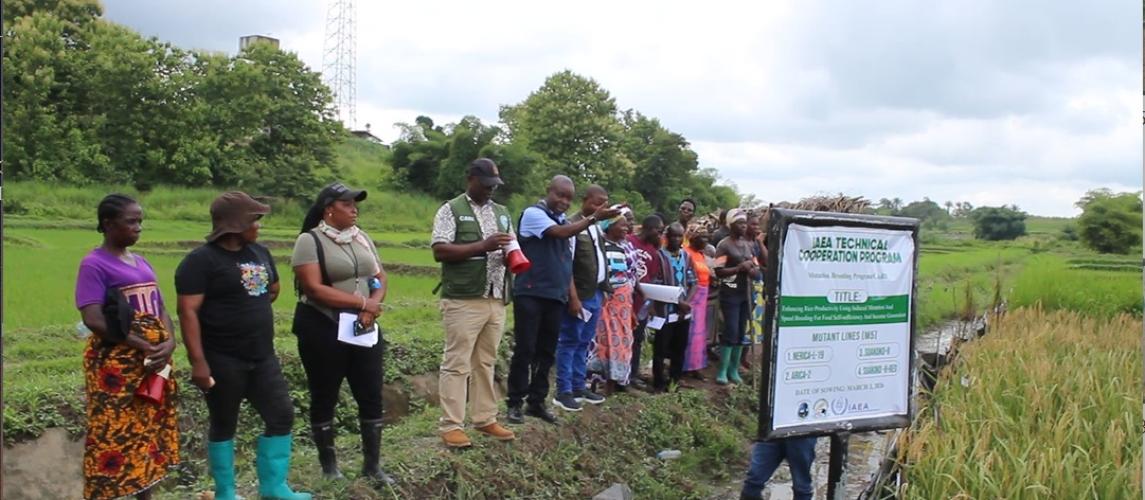
Welcoming participants at the Mutation Breeding Program Field Day on June 11, 2026, Dr. Arthur Bob Karnuah expressed appreciation to the IAEA for its continued support of CARI’s mutation breeding program. He emphasized that the purpose of the field day was to showcase research results and allow farmers to observe new rice varieties. “The essence of the Field Day is to showcase research results for the new rice so that farmers can have an idea to evaluate the crops,” he explained, noting that such demonstrations help build farmer confidence in adopting new technologies.
Dr. Kofi Bimpong, IAEA Technical Officer, congratulated the AfricaRice and CARI teams for their collaboration. He highlighted that while traditional breeding methods often take years and yield unstable results, speed breeding combined with mutation induction offers more reliable outcomes and responds directly to farmers’ needs.
Jobson A. Momo, Director General of the Seed Development Certification Agency (SDCA), underscored the urgency of innovation in agriculture. “Looking at the climate aggression today on crops, and the speedy growth rate of our population in Liberia, it is important to ensure that the issue of food security is addressed using mutation and speed breeding techniques,” he said. He noted that while scientists once required many years to develop new crop varieties, modern innovations now allow for the rapid development of strong varieties capable of addressing food security challenges.
The day’s central presentation was delivered by Dr. James S. Dolo, Plant Breeder, Principal Investigator, and Country Counterpart for the IAEA TCP. He outlined the progress of the program, coded LIR5003 (2022–2023) and LIR5004 (2024–2027), under the title “Enhancing Rice Productivity Using Induced Mutation and Speed Breeding for Food Self‑Sufficiency and Income Generation.” The project seeks to harness mutation induction and advanced breeding technologies to improve rice yields, shorten maturity periods, and strengthen Liberia’s food security. Current activities are focused on the sixth generation (M6) of mutant lines.
During his presentation, Dr. Dolo reported that the Suakoko‑8 mutants demonstrated remarkable reductions in maturity dates compared to parental lines:
-
Suakoko‑8 parental line (125 days) vs. mutant line (91.3 days) – 26.96% reduction
-
Suakoko‑8(R) parental line (125 days) vs. mutant line (101 days) – 19.20% reduction
-
NERICA‑L‑19 parental line (105 days) vs. mutant line (91 days) – 13.33% reduction
“These results show the potential of mutation breeding to deliver faster‑maturing rice varieties that can boost productivity and income generation for Liberian farmers,” Dr. Dolo stated.
Beyond varietal development, the program has strengthened Liberia’s agricultural research capacity through the provision of specialized molecular biology equipment from Miami, Singapore, and Vienna, as well as national and international fellowships for young Liberian agriculturists. Field trials have been conducted under rigorous experimental designs, ensuring that the mutant lines are thoroughly evaluated for yield attributes, stress tolerance, and overall performance.
In 2023, seeds from six rice varieties, including upland types (LAC 23, Bold Grain, NERICA‑4) and lowland types (NERICA‑L‑19, Suakoko‑8, ARICa‑2), were subjected to mutagenesis at the IAEA Seibersdorf Laboratory. The resulting generations have since been systematically assessed for viability, productivity, and adaptability.
Dr. Dolo expressed deep gratitude to the IAEA for its support, noting that the program has contributed significantly to agricultural research and development in Liberia. “Through the implementation of the TC Program, we are building both human and infrastructural capacity to diversify Liberia’s rice value chain and strengthen food security,” he emphasized.
The identification of Red Suakoko‑8 mutant lines represents a pivotal step in Liberia’s journey toward rice self‑sufficiency. With continued support from the IAEA and the dedication of CARI researchers, the mutation breeding program is poised to deliver new varieties that will transform rice production and improve livelihoods across the country.
