
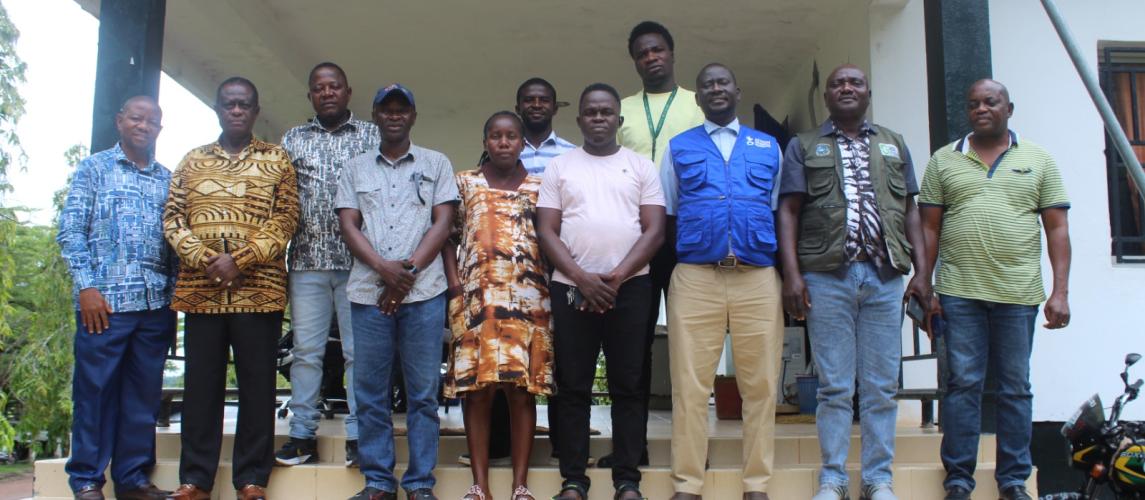
NOURISH Family Farms and CARI Strengthen Partnership for Sustainable Agriculture and Food Security
The Central Agricultural Research Institute (CARI) recently convened a Joint Technical Working Group meeting with partners of the Nutrition and Organic Uptake for Resilient Inclusive Sustainable Harvest for Family Farms (NOURISH Family Farms) Project to strengthen collaboration and coordinate efforts aimed at promoting sustainable agriculture, improved nutrition, and resilient livelihoods in Liberia.
Welcoming participants, Dr. Arthur Bob Karnuah emphasized the value of partnership among research institutions, development organizations, government agencies, and farmer groups in addressing key challenges facing Liberia’s agricultural sector. He highlighted the importance of leveraging the strengths of each institution to improve agricultural productivity, strengthen food security, and advance sustainable farming practices across the country.
Providing an overview of the initiative, Aongat Cuthbert, Deputy Country Director of Action Against Hunger (AAH), explained that the NOURISH Family Farms Project was launched in October 2026 and will run through 2028. The project seeks to support smallholder farmers through the adoption of organic and climate-smart agricultural practices that improve nutrition, increase productivity, and build resilience to environmental and economic shocks.
Victor Ngorbu, Head of Food Security and Livelihoods at AAH, presented the project’s implementation strategy. He noted that the initiative aims to establish a sustainable organic input value chain capable of improving livelihoods while contributing to more resilient food systems. According to him, the project addresses several longstanding challenges in Liberia’s agriculture sector, including low productivity among smallholder farmers, declining soil fertility, poor management of organic waste, limited access to quality and affordable organic inputs, high costs of conventional fertilizers, weak links between research institutions and farmers, and inadequate private sector investment in the organic input market.
The project aims to transform organic waste into high-quality agricultural inputs while creating economic opportunities for rural households. Key interventions include organic waste collection and aggregation, production of biofertilizers and biopesticides, quality assurance and certification, market development, farmer training, and support for sustainable agricultural enterprises.
The project’s success will depend on strong collaboration among implementing partners. Say No to Hunger Farmers’ Cooperative will mobilize farmers and communities; CARI will provide technical backstopping, research support, and training on agroecological practices; the Liberia Standards Authority will oversee quality standards and certification processes; the Ministry of Agriculture will deliver extension services and technical advice; while Action Against Hunger will coordinate and facilitate overall implementation.
The initiative directly targets 600 smallholder farmers in Nimba and Montserrado Counties, including 360 women and 240 men. In addition, approximately 842,000 people are expected to benefit indirectly through improved food systems, increased availability of organic inputs, and stronger agricultural value chains. Women will comprise 60 percent of direct beneficiaries, while significant attention will also be given to youth aged 18 to 35.
During the meeting, Aongat Cuthbert led discussions on the training materials, technical tools, and implementation guidelines required for successful project delivery. Participants reviewed plans for developing standardized training modules on compost production, agroecological farming techniques, soil fertility management, safe use of biofertilizers and biopesticides, agribusiness development, and nutrition-sensitive agriculture. The discussions also highlighted the need for practical training manuals, monitoring tools, demonstration materials, and effective community outreach strategies to encourage widespread adoption of organic farming practices.
Dr. James S. Dolo, Head of CARI’s Crop Program, facilitated discussions on establishing demonstration plots that will serve as hands-on learning centers for farmers and extension personnel. Participants examined site selection criteria, crop management protocols, monitoring systems, and knowledge-sharing mechanisms. The discussions further emphasized the importance of continuous farmer engagement, regular technical support, and capacity-building activities, including farmer field schools, to ensure effective adoption of new technologies and practices.
Partners also reviewed technical support arrangements and developed a joint action plan outlining responsibilities and priority activities for the project’s implementation phase. Representatives from Action Against Hunger, Green Cities Incorporated (GCI), Say No to Hunger Farmers’ Cooperative, and CARI agreed on coordinated actions to maximize project impact.
Dalitso Kuphanga, Program Manager of Green Cities Incorporated, highlighted biofertilizers and biopesticides as two of the project’s flagship innovations. He noted that these organic solutions can improve soil health, increase crop productivity, reduce production costs, and minimize dependence on synthetic agricultural inputs that may have negative environmental impacts.
The €375,000 project is implemented by a consortium comprising Green Cities Incorporated, Action Against Hunger, and Say No to Hunger Farmers’ Cooperative. Funding is provided by the European Union (EU) and Agence Française de Développement (AFD) under the ECOWAS framework.
The initiative focuses on four interconnected areas: soil health, nutrition, agroecology, and livelihood development. Expected outcomes include improved soil fertility, increased access to quality organic inputs, diversified farming systems, reduced crop losses, improved household nutrition, enhanced food security, and stronger income-generating opportunities for farming families. The project also seeks to strengthen farmer organizations and rural enterprises, helping communities build resilience to climate-related and economic shocks.
In closing, participants emphasized the need for sustained farmer mobilization, expanded training opportunities, stronger market linkages, and increased participation of local distributors. They stressed that developing a dynamic and inclusive market for organic inputs is critical to ensuring the long-term sustainability of project interventions.
Ultimately, the NOURISH Family Farms Project seeks to address major agricultural challenges, including declining soil fertility, poor waste management, limited access to quality inputs, climate variability, food insecurity, and weak extension systems. Through research, innovation, capacity building, market development, and institutional collaboration, the initiative aims to contribute to a more sustainable, productive, and resilient agricultural sector.
As agriculture remains the backbone of Liberia’s economy, the project offers a pathway toward healthier soils, improved nutrition, stronger farmer incomes, and enhanced food security. By empowering smallholder farmers, particularly women and youth, with the knowledge, resources, and partnerships needed to succeed, NOURISH Family Farms is expected to make a significant contribution to Liberia’s sustainable agricultural development.
